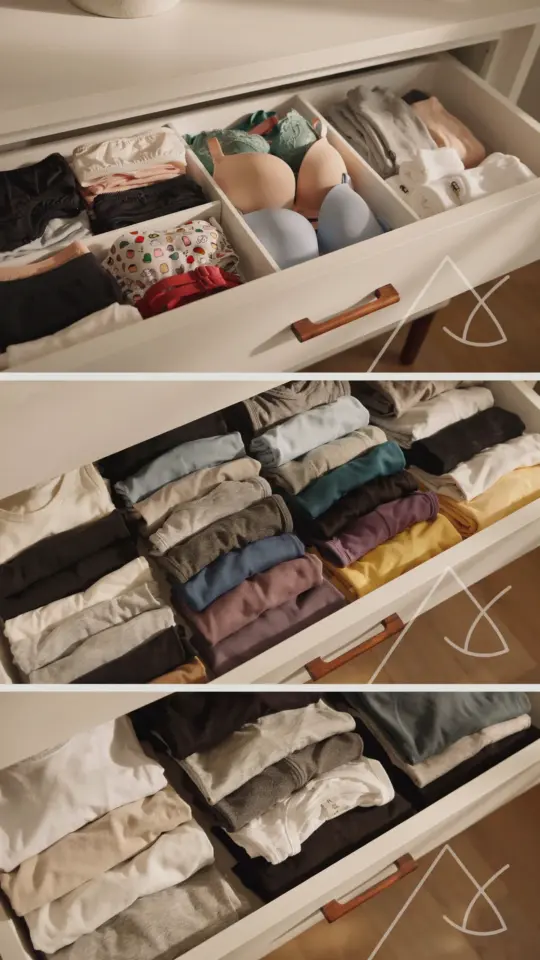
I used to think my sock drawer was a lost cause. You know the drill: you open it, see a tangled mess of mismatched pairs, and just grab whatever looks clean. But then I discovered that closet accessory organization starts with one simple tool: clear drawer organizers. These little plastic dividers turned my chaotic underwear drawer into a neat, functional space. And the best part? They work miracles in small apartments or cramped closets where every inch counts. Let me walk you through how I finally tamed my clothes clutter with clear dividers, stackable bins, and a few practical tricks.
Why clear drawer organizers are your best friend in small closets
I will be honest: I resisted clear drawer organizers for years because they looked a little too sterile. But after trying fabric bins and folded cardboard dividers that never stayed put, I gave in. The difference was immediate. Clear dividers let you see exactly what you own without digging through a pile. For small spaces, that visibility is gold. You can stack them vertically in deep drawers or slide them into shallow dresser drawers to keep socks, underwear, and scarves separated. They also prevent items from migrating into each other, which means you stop wasting time untangling. If you have a tiny closet or a shared bedroom, these organizers are a low cost, high impact upgrade.
Sorting your socks and underwear like a pro
Let us start with the most common pain point: socks and underwear. I recommend taking everything out of your drawer, tossing anything with holes or missing mates, and grouping similar items together. Then grab clear drawer dividers that fit the width of your drawer. For socks, I use dividers that create four to six compartments. One section for ankle socks, one for crew socks, one for athletic pairs, and one for dress socks. For underwear, I do the same: briefs in one, boxers in another, and shapewear in a third. The key is to keep each category small so nothing stacks too high. When you place them in the drawer, stand the socks up vertically (fold them into rectangles and place them upright) so you can see every pair at a glance. This method changed my morning routine completely.
Stackable bins for t-shirts and tank tops
Once your socks and underwear are sorted, move on to the next layer: t-shirts and tank tops. These are notorious for turning into wrinkled heaps. My solution is stackable bins, specifically the clear plastic kind with lids or open top designs that let you see the contents. I use shallow bins (about three to four inches tall) for folded t-shirts. I fold each shirt using the KonMari method, then stand them upright inside the bin. Then I stack a second bin on top for tank tops or camisoles. This keeps every piece visible and accessible without having to unstack everything. In a small closet where dresser space is limited, stackable bins let you double your vertical storage while keeping each layer organized. Just make sure the bins are uniform size so they stack securely.
Maximizing vertical space in shallow dresser drawers
Not all drawers are deep. Some are only a few inches tall, and that is where most people give up. But you can still maximize vertical space in shallow drawers by using clear dividers that are low profile. Look for dividers that are no taller than the drawer itself. Use them to create slim compartments for belts, ties, or rolled scarves. I have a shallow drawer that used to be a dumping ground for random accessories. Now it holds three rows of dividers: one for rolled up silk scarves, one for fabric belts, and one for small jewelry pouches. The trick is to roll items instead of folding them. Rolling uses less horizontal space and lets you see everything without digging. If you have very shallow drawers, try splitting them into two halves with a long divider, then adding smaller crosswise sections. This makes even the flattest drawer work harder.
Quick wins for scarves, belts, and other accessories
Accessories like scarves and belts often end up in a tangle. Clear drawer organizers solve this easily. For scarves, I use a single long compartment that runs the width of the drawer, then fold each scarf into a flat rectangle and stack them like files. For belts, I roll them loosely and place them in individual small bins or compartments. One thing I learned the hard way: do not overcrowd. Leave a little breathing room so you can grab one item without disturbing the others. Here is a quick checklist I follow for accessory organization:
- Roll scarves instead of folding to save space and reduce wrinkles.
- Use small clear divider boxes for hair ties, clips, and small jewelry.
- Store belts in a dedicated shallow compartment to prevent kinks.
- Keep rarely used accessories (e.g., formal ties) in a separate bin at the back.
- Label the outside of the drawer with a small sticky note if you share space.
These small habits turn a messy drawer into a functional system that stays tidy for weeks.
Maintaining a clutter-free drawer system over time
Let us be real: no organization method works if you do not maintain
#closetorganization #accessoryorganization #drawerorganizers #smallspacetips #closetorganizationtips
Leave a Comment