You are sitting on the edge of your bed at 11:47 PM, phone in hand, reading this instead of sleeping. Something feels stuck, like a song on repeat you didn’t choose. I have been there, not once, but enough times to recognize the exact weight of it. This how to restart your life step by step guide is not about becoming a new person. It’s about getting out of your own way, one small, concrete move at a time.
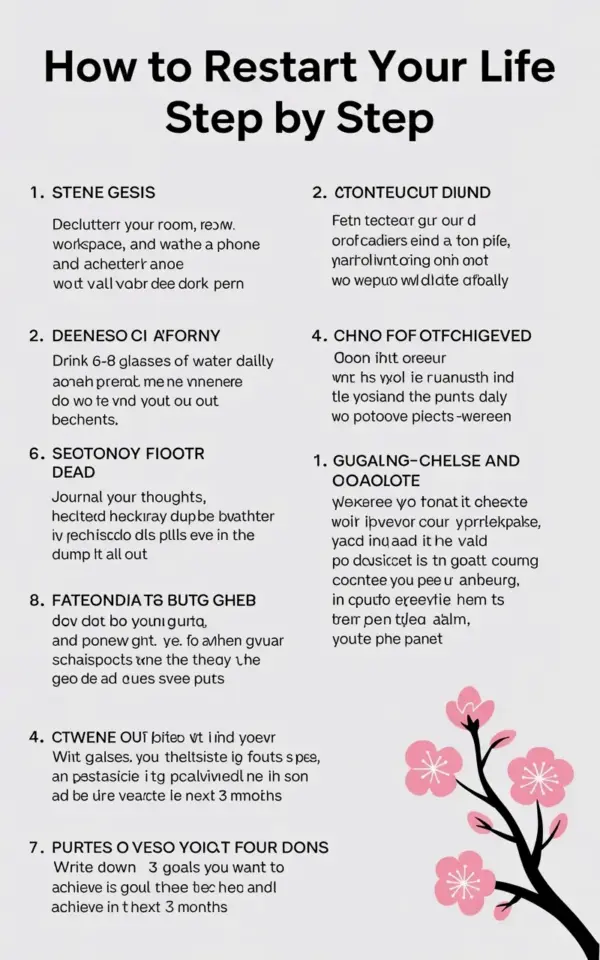
Ok so, here is the thing. A restart sounds dramatic, like throwing everything into a dumpster and moving to a cabin with no Wi-Fi. But real life resets are quieter. They are a series of deliberate, slightly boring choices that stack into a completely different reality by next season. Look, the infographic that inspired this post says it perfectly: seven clean, numbered sections with white space around each one, plus a little pink cherry blossom branch in the corner. That visual is the whole vibe. Space to breathe, room to grow, and zero pressure to be perfect.
Step 1: Conduct a Brutal, Honest Life Audit
Before you can change anything, you have to look at what is actually there. Not what you tell yourself should be there, but what is real. Get a piece of paper, or open a blank note, and divide your life into five simple columns: energy, money, relationships, body, and brain.
Now, rate each one from 1 to 10 without overthinking it. Your first number is usually the correct one. The goal here is not to fix anything yet. It is to stop pretending that the job you hate, or the friend who drains you, or the habit of sleeping at 3 AM is somehow working. Honestly, the audit takes twenty minutes and it will sting a little. That sting is just information. It is not a verdict on your entire existence, it is a map of where the potholes are.
- List the one thing in each category that drains you the most.
- List the one thing in each category that actually gives you energy.
- Give yourself a specific score. No hedging, no “well, it depends”.
This is step one because everything else in this guide relies on you being honest with yourself from the very start. If you lie here, the whole reset falls apart.
Step 2: Accept the Mess and Forgive the Past
Listen, I am not going to tell you to “just let it go,” because that is terrible advice. Some of you have genuinely hard stuff back there: failed relationships, financial hits, wasted years, stuff you said that you cannot take back. Forgiving yourself feels like a betrayal of logic sometimes.
But here is a reframe that actually worked for me. Forgiveness is not saying it didn’t matter. Forgiveness is saying, “Look, that chapter is written and I refuse to read it out loud every single day anymore.” It is a practical move, not a spiritual one. The energy you spend replaying the mistake is energy that could go into the future you are trying to build. It is a weird, mildly odd thing, but I literally wrote “That was then, this is now” on a sticky note and left it on my bathroom mirror for three months. Dumb? Maybe. Did it work? Yeah, it kinda did.
You have to make peace with the fact that you did the best you could with the information you had at that exact moment. Hindsight is a liar. It makes you think you should have known better, but you couldn’t have.
Step 3: Define Your Future Self, Not Your Future To-Do List
Here is the mistake we all make. We decide to restart and immediately write down a list of 50 things to do. New gym routine, new diet, new business, learn Japanese, wake up at 5 AM. That is chaos in a trench coat. It never sticks because you are changing behaviors without changing the identity underneath them.
Instead of asking “What should I do every day?”, ask yourself this: “Who is the person that lives the life I want?” Get specific about that person. Not in a fake vision-board way, but in a practical, grounded way. Does that person sleep before midnight? Do they answer emails like a normal human instead of panicking at 10 PM? Do they have calm mornings or rushed ones?
I use the word “restart” loosely here because it is not really about flipping a switch. It is about becoming the type of person who does the small things. When you get crystal clear on the character, the checklist almost writes itself. And honestly, this is the step most people skip. They want the Instagram highlights, but they skip the core identity work that makes the highlight reel possible.
Step 4: Design a Tiny, Unmissable Daily Routine
Ok so, the infographic talks about clean sections and lots of white space, and that is exactly what your day needs too. Do not overhaul your entire schedule. That is violence against your own willpower. Pick three anchors for your day. I call them anchors because they keep the ship from drifting. One in the morning, one at midday, one in the evening.
The morning anchor is something that grounds you before the world grabs you. It could be making your bed, drinking a glass of water, or sitting in silence for exactly two minutes. The midday anchor is a reset to stop the spiral. For me, it’s a 10-minute walk around the block without my phone. I hate that I love it. The evening anchor is a signal to your brain that the day is done, like putting your phone in another room or writing down tomorrow’s top three tasks.
That’s it. That is the whole routine. You do this for two weeks before you even think about adding anything else. It works because it is boring and small and impossible to fail at. Listen, if you can’t do the boring small version, you definitely can’t do the exciting big version.
Step 5: Take One Uncomfortable Step
Here is the part where the restart actually starts to feel real. You have to do something that scares you a little. Not terrifying, just uncomfortable. A step you have been avoiding because it might not work. Send the application. Make the phone call. Post the writing. Book the appointment. Ask the question.
I remember the exact moment I realized this. I was avoiding a single email for three days. Three days! The email took me four minutes to write once I finally did it. The anticipation was an imaginary monster. The email itself was a boring task. That is how it always goes. We spend more energy dreading the thing than doing the thing. It is maddening, and honestly, a little embarrassing to admit.
Pick the smallest uncomfortable thing that you have been circling for months. Do not pick the biggest one. Pick the one that gives you a tiny flutter of nerves but not a full panic attack. Do it today, not Monday. Resets don’t wait for a perfect calendar date.
Step 6: Protect the New Version of You
When you start acting differently, the world reacts weirdly, and some of your friends will not be happy about it. That is a fact. You say no to a night out to work on your project and suddenly you are “different” or “too serious.” It hurts, but it is a good sign. It means the change is taking hold.
Your only job during this step is to protect the new behavior like it’s a tiny flame in the wind. That might mean turning off notifications from a specific group chat. It might mean having a prepared line for when someone asks why you are “acting weird.” Something like, “I’m just focusing on my health right now.” That’s all. No one needs the whole essay.
There was a period of time when I nearly quit a good habit because a friend laughed at my exacto-knife-sharp boundaries, and I almost laughed along to keep the peace. Big mistake. You have to be willing to be a little boring or a little distant for a season. The right people will adjust, and the wrong ones will filter themselves out.
Step 7: Honor the Incremental Wins
The last step is to actually notice that things are changing. Do not wait for the big, dramatic transformation. That is a trap. The transformation is just a bunch of tiny ignored moments stacked on top of each other. You slept before midnight for five days in a row. Nice. You didn’t lose your temper at work today. Good. You made a green smoothie and didn’t hate it. Excellent.
I want you to celebrate those. Not with a parade, but with a simple acknowledgment. Say thank you to yourself. Put a checkmark on a piece of paper. Send a voice note to a friend that says, “I did the thing and it felt ok.” This is not vanity. This is wiring your brain to repeat the behavior.
The pink cherry blossom on that infographic in the bottom corner? That’s the perfect metaphor. It is small, it is beautiful, and it does not appear until the branches have done their quiet work underneath the surface. Your progress will look like that too. Not always obvious, but definitely blooming.
Restarting your life is not a single dramatic event. It is a series of seven small decisions you make and then make again tomorrow. Pick one phase from this guide and start there. You have already done the hardest part, you admitted something needs to change. Now move, even if it is tiny. Future you is actually kind of grateful right now.
Leave a Comment