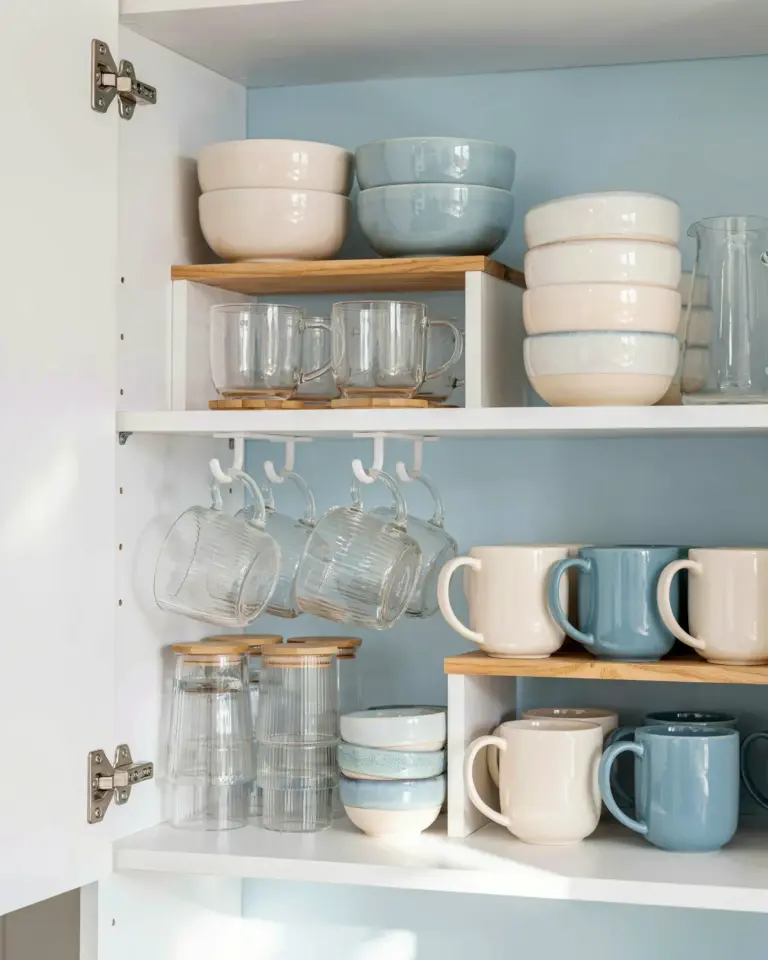
So you’ve opened your kitchen cupboard and a mug immediately fell out and clattered into the sink. That’s not a judgement, it’s a shared experience. And it’s the exact reason you’re here looking for proper cupboard organisation. Honestly, sorting out the chaos of your kitchen cupboards is one of the most satisfying ways to start an organising day, mainly because you can see the results immediately. Every time you open the door after you’re done, you get a little hit of calm. That’s what we’re building today.
The goal isn’t perfection or a magazine spread. Look, we just want a system where you can grab a coffee mug without playing a dangerous game of Jenga. We want plates to slide out without dragging three other dishes with them. This guide is for absolute beginners, so we will start from zero. We’ll talk about the best way to clear things out, how to use the “eye level” rule, and the specific tools like sturdy stackers and clear bins that actually make a difference. You will end up with a kitchen cupboard setup that works for your actual life.
Start with a ruthless cupboard clear out (yes, all of it)
You can’t organise clutter, you can only organise items you actually want to keep. So, take everything out of your cupboards. All of it. Put the mugs on the counter, the plates on the table, the bowls wherever they fit. You need to see the sheer volume of stuff you own before you can decide where it lives.
This is where you have to be honest with yourself. Do you really need four different sets of side plates for a household of two? Probably not. Grab a box for donations right now. If you haven’t used a particular casserole dish since before the pandemic, it needs to go. Here’s the thing: holding onto that one weird mug from a work event in 2015 is fine, but it doesn’t deserve prime real estate. Create a “maybe” pile if you have to, but put it in the hallway, not back in the cupboard.
This is the best way to maximise eye-level kitchen cupboard space
The golden rule of kitchen cupboard organisation is that you store things where you actually look first. For most people, that’s the shelf right at eye level. This prime spot should be dedicated to the things you use daily: your go-to coffee mug, the glass you drink water from all day, and the bowl you use for cereal. It makes zero sense to put your fancy champagne flutes there when you only touch them twice a year.
When you place items back, keep the heaviest and bulkiest stuff on the bottom shelf. This is a safety thing, for sure, but it also just makes sense. You don’t want to be reaching up for a heavy cast iron pan with one hand while you’re half asleep. If you have short people in the house (kids, shorter partners), give them a lower shelf for their own cups and bowls. That way they don’t have to climb the counters to get breakfast ready.
The clever plate storage hack for messy stacks
Stacking plates directly on top of one another is actually the biggest waste of space in most cupboards. They topple over, and you always have to lift the entire stack just to get the one on the bottom. The simplest fix is to use vertical plate organisers or sturdy stackers. You see those metal or wooden racks in stores and think they’re just for show, but honestly, they change the game.
Instead of a wobbly tower of eight dinner plates, you can slot them in on their side, like files in a drawer. This means you can see every single plate instantly. To grab a side plate from the middle, you just slide it out. No more lifting, no more scraping the plate underneath with your fingernails. It also allows you to store a lot more in a small space because you can use the vertical height of the cupboard that usually gets wasted. If you have deep cupboards, put the plates you use daily at the front of the rack, and the special occasion ones at the back.
How to use risers and clear bins for deep kitchen cupboards
Deep, dark corner cupboards are the place where things go to die. You shove the food processor in there and then buy a new one because you “couldn’t find it”. To fix this, you need to create layers. This is where kitchen cupboard risers come in. They basically create a second floor in your cupboard, so you can put mugs on top and a row of smaller Tupperware underneath. It sounds simple, but it doubles your storage capacity instantly.
For loose items that roll around, clear bins are your best friend. Snack bags, baby pouches, spice sachets, or even those odd-shaped miso paste tubes; they all belong in a clear container. Use a bin or clear storage boxes for all your baking supplies, so you can see exactly how much flour or sugar you have left. Clear bins are non-negotiable for this. If you can’t see it, you won’t use it, and you’ll definitely buy a duplicate next week.
A real example of small awkward cupboard storage
Let me tell you about my own kitchen situation, because it’s far from perfect. I have a tiny corner cupboard that is really deep, but the opening is narrow. It’s the weirdest shape. For ages, I just shoved random bowls in there and closed the door quickly. This past weekend, I tackled it. I took out everything and measured the depth. Then I bought two slim, steel wire shelves that fit perfectly.
Now, the bottom shelf holds my slow cooker (with the lid wedged safely upright, no more chipped handles). The top shelf I built with the riser holds my most used measuring cups and mixing bowls. Actually, I printed little labels for the containers, which I thought was super cheesy, but now my boyfriend can actually find the measuring spoons without asking me, which is honestly a miracle. It proves you don’t need a huge pantry to have an organised system, you just need to be a bit clever about the space you have.
Why you should steal vertical space for extra cups
If you have a tall gap above your dinner plates or below a shelf, you’re wasting space. You can use a simple under-shelf basket to hold coffee mug lids or those teacups that don’t match any set. Hanging mugs on hooks under a shelf might not be for everyone, but it looks amazing and frees up serious shelf space. I have a few small S-hooks hanging under one of my upper cabinets, where I store my most used latte mugs.
Another idea for vertical storage is stacking. And no, I don’t mean putting a full stack of mugs inside each other (that leads to chipped handles and angry mornings). I mean using mug stackers, which are those two-tier racks specifically designed for cups. They let you stack two mugs in the height of one and a half. It’s a specific tool, but if you collect mugs (which I definitely do), it’s the perfect solution for storing them all without them collecting dust.
Maintaining your kitchen cupboard setup
You’ve done the hard work, so now we need to make sure it stays that way. The best way to keep things tidy is to create a “home” for every single item, and then force yourself to put it back. It’s easier said than done, I know. I have a habit of just shoving a clean mug on the counter next to the coffee maker, but when the cupboard is this organised, it actually feels wrong to not put it away.
Set aside five minutes every Sunday to do a quick reset. Put the stackers back in place, tidy the clear bins, and give the shelves a quick wipe with a damp cloth. Look, things will get messy again, that’s the nature of cooking. But now, it takes seconds to find things and minutes to reset, which is way better than a weekend-long decluttering session. You’ll actually enjoy opening your tidy kitchen cupboards every morning. And if you want to remember this setup, save this idea to your Home Storage board on Pinterest for later.
Leave a Comment